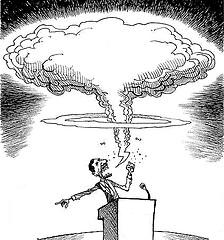
United Nations speical envoy Ibrahim Gambari has left Myanmar empty handed and his departure may signal the end of a small door through which the generals and the free world could have crossed into a place where a peaceful solution to the oppression in Myanmar was possible. Nehginpao Kipgen sees two paths: neither pleasant.
From Irrawaddy:
Ibrahim Gambari, a seasoned Nigerian diplomat who has been tasked with coordinating the United Nations” efforts to end the political impasse in Burma, wrapped up his latest visit to the country on March 10. The outcome of his mission, which ended without any improvement in the situation, was about as good as could be expected.
In the absence of a mandate from the UN Security Council, there was little chance that the special envoy could achieve anything concrete. When the Security Council refused to pass a resolution on Burma on January 12, it effectively ensured that Gambari”s efforts would become an exercise in futility.
Prior to his visit to Burma, the UN special envoy headed to neighboring countries to build some sort of consensus. As anticipated by many, including Burmese opposition groups and members of the United Nations, nothing has come of Gambari”s travels around the region.
Gambari was reportedly encouraged when the countries he visited paid lip service to the need for real improvement in Burma. But in the end, all he received were words without concrete commitments. China remains as determined as ever to expand its influence in the country for its own purposes, while India is still primarily concerned with countering Beijing”s growing clout.
The game being played by China and India is not about national security or ideology; they are not interested in spreading communism or democracy. The driving force behind the Burma policies of the two countries is economic interest.
Despite the shortcomings of UN efforts to date, however, we should acknowledge, with reservations, the good offices of Secretary-General Ban Ki-moon in his efforts to bring about some resolution of Burma”s longstanding conflicts. Although substantive results have yet to be borne, the first meeting of the 14-nation “Group of Friends of the Secretary-General on Myanmar” was convened on December 19, 2007.
There are two possible ways to end Burma”s current situation: through international intervention or by a popular uprising (supported by disgruntled military personnel). Although it may be naïve to even consider it, the swiftest way to bring change would be by military intervention, either by the United States or by the United Nations. Continue Reading »

 My name is Jeff Hess and I’m a biblioholic. I own hundreds of books. Not valuable books, mostly Science Fiction paperbacks and text books, tomes rescued by the bag from library book sales. A few years ago, in the interest of not burying myself, I began reading more books from the library and taking notes. My electronic chapbook was born.
 I’m constantly tossing interesting websites into what I call my blogpile. Some of them find their way here in the form of regular posts, but more often than not they languish and get buried deeper in the pile. The end result is that I have to go back and do a bit of shoveling. Today’s item is
  I could never bring myself to forward all the email jokes, cartoons and other Internet comedy that land in my inbox. But then I started posting the ones my dad sends me. Judging from my comments and emails, my dad has become one of my greatest blogging assets. So for your morning Irish chuckle I present: