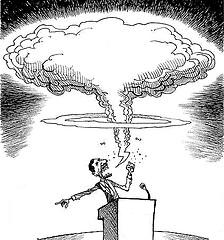
I could never bring myself to forward all the email jokes, cartoons and other Internet comedy that land in my inbox. But then I started posting the ones my dad sends me. Judging from my comments and emails, my dad has become one of my greatest blogging assets. So for your morning blog head scratch I present: From My Dad.
How to Win in Iraq
And how to lose.
BY ARTHUR HERMAN
Thursday, March 29, 2007 12:01 a.m. EDT
“It is best if an enemy nation comes and surrenders of its own accord.” –Du You (735-812)
To the student of counterinsurgency warfare, the war in Iraq has reached a critical but dismally familiar stage.
On the one hand, events in that country have taken a more hopeful direction in recent months. Operations in the city of Najaf in January presaged a more effective burden-sharing between American and Iraqi troops than in the past. The opening moves of the so-called surge in Baghdad, involving increased American patrols and the steady addition of more than 21,000 ground troops, have begun to sweep Shiite militias from the streets, while their leader, Moqtada al-Sadr, has gone to ground. Above all, the appointment of Lt. Gen. David Petraeus, the author of the U.S. Army’s latest counterinsurgency field manual, as commander of American ground forces in Iraq bespeaks the Pentagon’s conviction that what we need to confront the Iraq insurgency is not more high-tech firepower but the time-tested methods of unconventional or “fourth generation” warfare.
In Washington, on the other hand, among the nation’s political class, the growing consensus is that the war in Iraq is not only not winnable but as good as lost–Rep. Henry Waxman of California, for one, has proclaimed that the war is lost. Politicians who initially backed the effort, like Democratic Sens. Hillary Clinton and Joseph Biden, and Republican Reps. Walter Jones and Tom Davis, have been busily backing away or out, insisting that Iraq has descended into civil war and that Americans are helpless to shape events militarily. A growing number, like Rep. John Murtha, even suggest that the American presence is making matters worse. The Democratic Party has devoted much internal discussion to whether and how to restrict the President’s ability to carry out even the present counterinsurgency effort.
In short, if the battle for the hearts and minds of Iraqis still continues and is showing signs of improvement, the battle for the hearts and minds of Congress, or at least of the Democratic majority, seems to be all but over. In the meantime, still more adamant on the subject are many of our best-known pundits and media commentators. According to Thomas Friedman of the New York Times, who speaks for many, Iraq “is so broken it can’t even have a proper civil war,” and America is therefore now left with but a single option: “how we might disengage with the least damage possible.” To the left of Mr. Friedman and his ilk are the strident and often openly anti-American voices of organizations like MoveOn.org.
Continue Reading »

 It’s difficult to write an introduction to this. I’m no longer surprised by the shameful behavior of that horrible but tiny world of doctors and scientists in search of answers who are blinded by their own ambitions. The second David Vetter had ought not to have been born. The doctors had other plans.
 My name is Jeff Hess and I’m a biblioholic. I own hundreds of books. Not valuable books, mostly Science Fiction paperbacks and text books, tomes rescued by the bag from library book sales. A few years ago, in the interest of not burying myself, I began reading more books from the library and taking notes.
  I’m constantly tossing interesting websites into what I call my blogpile. Some of them find their way here in the form of regular posts, but more often than not they languish and get buried deeper in the pile. The end result is that I have to go back and do a bit of shoveling. Today’s item is
 The sad thing is that I know that the answer to my question is yes. And I’m sure these refugees from a rejected Monty Python skit in Columbus will prove me right some time soon. But for now HB 287 is as good example of any that they have no idea what they really need to be doing down there to make Ohio succeed.
 In a world where the innocent are malnourished, abused and slaughtered on a daily basis, this is not a big thing, but it still frosted my shorts this morning when I read