5 July 2009
5 July 2009
ON SAUL BELLOW…
0830 by Jeff HessFrom Daily Routines:
When he hadn’t returned for lunch, I carried a bite out to him and found him typing vigorously, his face and his T-shirt covered with blood. Composing for Saul is an aerobic activity. He sweats when he writes, and peels off layers of clothing. When he is concentrating particularly hard, he screws up his left eye and emits a sound that’s a cross between the panting of a long-distance runner and a breathy whistle: “Windy suspirations of forced breath.”
5 July 2009
FROM MY CHAPBOOK…
0230 by Jeff HessFound in my electronic chapbook.
…a life chosen to maximize joy may be very different from one chosen to minimize pain. p. 212
From The Midnight Disease: The Drive to Write, Writer”s Block and the Creative Brain by Alice W. Flaherty.
4 July 2009
FROM MY DAD…
2030 by Jeff Hess I could never bring myself to forward all the email jokes, cartoons and other Internet comedy that land in my inbox. But then I started posting the ones my dad sends me. Judging from my comments and emails, my dad has become one of my greatest blogging assets. So for your evening blog history lesson on this 4th of July, I present: From My Dad.
Have you ever wondered what happened to the 56 men who signed the Declaration of Independence?
Five signers were captured by the British as traitors, and tortured before they died.
Twelve had their homes ransacked and burned. Two lost their sons serving in the Revolutionary Army; another had two sons captured.Nine of the 56 fought and died from wounds or hardships of the Revolutionary War.
They signed and they pledged their lives, their fortunes, and their sacred honor.
What kind of men were they?
Twenty-four were lawyers and jurists. Eleven were merchants, nine were farmers and large plantation owners; men of means, well educated, but they signed the Declaration of Independence knowing full well that the penalty would be death if they were captured.
Carter Braxton of Virginia, a wealthy planter and trader, saw his Ships swept from the seas by the British Navy.
He sold his home and properties to pay his debts, and died in rags.Thomas McKeam was so hounded by the British that he was forced to move his family almost constantly. He served in the Congress without pay, and his family was kept in hiding. His possessions were taken from him, and poverty was his reward.
Vandals or soldiers looted the properties of Dillery, Hall, Clymer, Walton, Gwinnett, Heyward, Ruttledge, and Middleton.
At the battle of Yorktown , Thomas Nelson, Jr., noted that the British General Cornwallis had taken over the Nelson home for his headquarters. He quietly urged General George Washington to open fire. The home was destroyed, and Nelson died bankrupt.
Francis Lewis had his home and properties destroyed. The enemy jailed his wife, and she died within a few months.
John Hart was driven from his wife’s bedside as she was dying. Their 13 children fled for their lives. His fields and his gristmill were laid to waste. For more than a year he lived in forests and caves, returning home to find his wife dead and his children vanished. Some of us take these liberties so much for granted, but we shouldn’t. So, take a few minutes while enjoying your 4th of July holiday and silently thank these patriots.
4 July 2009
4 July 2009
IN CONGRESS, July 4, 1776…
1200 by Jeff Hess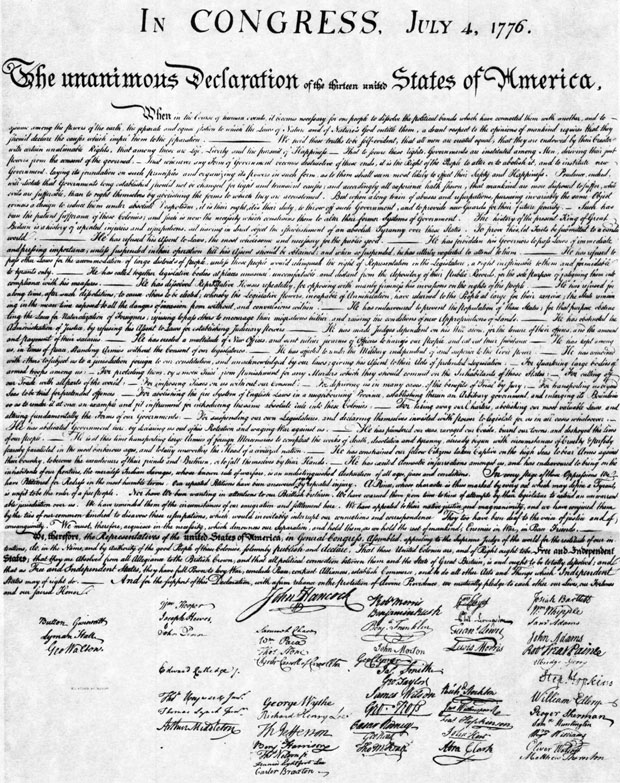
The unanimous Declaration of the thirteen united States of America,
When in the Course of human events, it becomes necessary for one people to dissolve the political bands which have connected them with another, and to assume among the powers of the earth, the separate and equal station to which the Laws of Nature and of Nature’s God entitle them, a decent respect to the opinions of mankind requires that they should declare the causes which impel them to the separation.
We hold these truths to be self-evident, that all men are created equal, that they are endowed by their Creator with certain unalienable Rights, that among these are Life, Liberty and the pursuit of Happiness. –That to secure these rights, Governments are instituted among Men, deriving their just powers from the consent of the governed, –That whenever any Form of Government becomes destructive of these ends, it is the Right of the People to alter or to abolish it, and to institute new Government, laying its foundation on such principles and organizing its powers in such form, as to them shall seem most likely to effect their Safety and Happiness. Prudence, indeed, will dictate that Governments long established should not be changed for light and transient causes; and accordingly all experience hath shewn, that mankind are more disposed to suffer, while evils are sufferable, than to right themselves by abolishing the forms to which they are accustomed. But when a long train of abuses and usurpations, pursuing invariably the same Object evinces a design to reduce them under absolute Despotism, it is their right, it is their duty, to throw off such Government, and to provide new Guards for their future security. -Such has been the patient sufferance of these Colonies; and such is now the necessity which constrains them to alter their former Systems of Government. The history of the present King of Great Britain [George III] is a history of repeated injuries and usurpations, all having in direct object the establishment of an absolute Tyranny over these States. To prove this, let Facts be submitted to a candid world.
4 July 2009
ON TONI MORRISON…
0830 by Jeff HessFrom Daily Routines:
Well, those that need reworking I do as long as I can. I mean, I’ve revised six times, seven times, thirteen times. But there’s a line between revision and fretting, just working it to death. It is important to know when you are fretting it; when you are fretting it because it is not working, it needs to be scrapped.
4 July 2009
FROM MY CHAPBOOK…
0230 by Jeff HessFound in my electronic chapbook.
“No one, ever, can give the exact measure of his needs, his apprehensions or his sorrows; and human speech is like a cracked cauldron on which we bang out our tunes that make bears dance, when we want to move the starts to pity.” Flaubert. p. 211
From The Midnight Disease: The Drive to Write, Writer”s Block and the Creative Brain by Alice W. Flaherty.
3 July 2009
FROM MY DAD…
2030 by Jeff HessI could never bring myself to forward all the email jokes, cartoons and other Internet comedy that land in my inbox. But then I started posting the ones my dad sends me. Judging from my comments and emails, my dad has become one of my greatest blogging assets. So for your evening blog chuckle I present: From My Dad.
Long ago and far away,
In a land that time forgot,
Before the days of Dylan,
Or the dawn of Camelot.There lived a race of innocents,
And they were you and me,
Long ago and far away
In the Land That Made Me Me.Oh, there was truth and goodness
In that land where we were born,
Where navels were for oranges,
And Peyton Place was porn.For Ike was in the White House,
And Hoss was on TV,
And God was in His heaven
In the Land That Made Me Me.We learned to gut a muffler,
We washed our hair at dawn,
We spread our crinolines to dry
In circles on the lawn.And they could hear us coming
All the way to Tennessee,
All starched and sprayed and rumbling
in the Land That Made Me Me.We longed for love and romance,
And waited for the prince,
And Eddie Fisher married Liz,
And no one’s seen him since.We danced to “Little Darlin”,
And Sang to “Stagger Lee”
And cried for Buddy Holly
In the Land That Made Me Me.Only girls wore earrings then,
And three was one too many,
And only boys wore flat-top cuts,
Except for Jean McKinney.And only in our wildest dreams
Did we expect to see
A boy named George with Lipstick,
In the Land That Made Me Me.We fell for Frankie Avalon,
Annette was oh, so nice,
And when they made a movie,
They never made it twice.We didn’t have a Star Trek Five,
Or Psycho Two and Three,
Or Rockey-Rambo Twenty
In the Land That Made Me Me.Miss Kitty had a heart of gold,
And Chester had a limp,
And Reagan was a Democrat
Whose co-star was a chimp.We had a Mr Wizard,
But not a Mr T,
And Oprah couldn’t talk, yet
In the Land That Made Me Me.We had our share of heroes,
We never thought they’d go,
At least not Bobby Darin,
Or Marilyn Monroe.For youth was still eternal,
And life was yet to be,
And Elvis was forever,
In the Land That Made Me Me.We’d never seen the rock band
That was Grateful to be Dead,
And Airplanes weren’t named Jefferson ,
And Zeppelins weren’t Led.And Beatles lived in gardens then,
And Monkees in a tree,
Madonna was a virgin
In the Land That Made Me Me.We’d never heard of Microwaves,
Or telephones in cars,
And babies might be bottle-fed,
But they weren’t grown in jars.And pumping iron got wrinkles out,
And “gay” meant fancy-free,
And dorms were never coed
In the Land That Made Me Me.We hadn’t seen enough of jets
To talk about the lag,
And microchips were what was left at
The bottom of the bag.And Hardware was a box of nails,
And bytes came from a flea,
And rocket ships were fiction
In the Land That Made Me Me.Buicks came with portholes,
And side show came with freaks,
And bathing suits came big enough
To cover both your cheeks.And Coke came just in bottles,
And skirts came to the knee,
And Castro came to power
In the Land That Made Me Me.We had no Crest with Fluoride,
We had no Hill Street Blues,
We all wore superstructure bras
Designed by Howard Hughes.We had no patterned pantyhose
Or Lipton herbal tea
Or prime-time ads for condoms
In the Land That Made Me Me.There were no golden arches,
No Perriers to chill,
And fish were not called Wanda,
And cats were not called Bill.And middle-aged was thirty-five
And old was forty-three,
And ancient was our parents
In the Land That Made Me Me.But all things have a season,
Or so we’ve heard them say,
And now instead of Maybelline
We swear by Retin-A.And they send us invitations
To join AARP,
We’ve come a long way, baby,
From the Land That Made Me Me.So now we face a brave new world
In slightly larger jeans,
And wonder why they’re using
Smaller print in magazines.And we tell our children’s children
Of the way it used to be,
Long ago, and far away
In the Land That Made Me Me.
3 July 2009
3 July 2009
ON ERNEST HEMINGWAY…
0830 by Jeff HessFrom Daily Routines:
When I am working on a book or story I write every morning as soon after first light as possible. There is no one to disturb you and it is cool or cold and you come to your work and warm as you write. You read what you have written and, as you always stop when you know what is going to happen next, you go on from there. You write until you come to a place where you still have your juice and you know what will happen next and you stop and try to live through until the next day when you hit it again. You have started at six in the morning, say, and may go on until noon or be through before that. When you stop you are as empty, and at the same time never empty but filling, as when you have made love to someone you love. Nothing can hurt you, nothing can happen, nothing means anything until the next day when you do it again. It is the wait until the next day that is hard to get through.
3 July 2009
FROM MY CHAPBOOK…
0230 by Jeff HessFound in my electronic chapbook.
“I have forced myself to begin writing when I”ve been utterly exhausted, when I”ve felt my soul as thin as a playing card… and somehow the activity of writing changes everything.” Joyce Carol Oates. p. 206
From The Midnight Disease: The Drive to Write, Writer”s Block and the Creative Brain by Alice W. Flaherty.
2 July 2009
FROM MY DAD…
2030 by Jeff HessI could never bring myself to forward all the email jokes, cartoons and other Internet comedy that land in my inbox. But then I started posting the ones my dad sends me. Judging from my comments and emails, my dad has become one of my greatest blogging assets. So for your evening blog chuckle I present: From My Dad.
In 1909:
The average life expectancy was 47 years.
Only 14 percent of the homes had a bathtub.
Only 8 percent of the homes had a telephone.
There were only 8,000 cars and only 144 miles of paved roads.
The maximum speed limit in most cities was 10 mph.
The tallest structure in the world was the Eiffel Tower.
The average wage in 1908 was 22 cents per hour.
The average worker made between $200 and $400 per year.
A competent accountant could expect to earn $2,000 per year, a dentist $2,500 per year, a veterinarian between $1,500 and $4,000 per year, and a mechanical engineer about $5,000 per year.
More than 95 percent of all births took place at home.
Ninety percent of all doctors had no college education. Instead, they attended so-called medical schools, many of which were condemned in the press and the government as “substandard.”
Sugar cost four cents a pound.
Eggs were fourteen cents a dozen.
Coffee was fifteen cents a pound.
Most women only washed their hair once a month, and used borax or egg yolks for shampoo.
Canada passed a law that prohibited poor people from entering into their country for any reason.
Five leading causes of death were: 1. Pneumonia and influenza, 2. Tuberculosis, 3. Diarrhea, 4. Heart disease and 5. Stroke.
The American flag had 45 stars.
The population of Las Vegas , Nevada, was only 30.
Crossword puzzles, canned beer, and ice tea hadn’t been invented yet.
There was no Mother’s Day or Father’s Day.
Two out of every 10 adults couldn’t read or write. Only 6 percent of all Americans had graduated from high school.
Marijuana, heroin, and morphine were all available over the counter at the local corner drugstores. Back then pharmacists said, “Heroin clears the complexion, gives buoyancy to the mind,regulates the stomach and bowels, and is, in fact, a perfect guardian of health.”
Eighteen percent of households had at least one full-time servant or domestic help.
There were about 230 reported murders in the entire USA.
What a difference 100 years can make.
2 July 2009
2 July 2009
ON ARTHUR MILLER…
0830 by Jeff HessFrom Daily Routines:
I wish I had a routine for writing. I get up in the morning and I go out to my studio and I write. And then I tear it up! That’s the routine, really. Then, occasionally, something sticks. And then I follow that. The only image I can think of is a man walking around with an iron rod in his hand during a lightning storm.
2 July 2009
FROM MY CHAPBOOK…
0230 by Jeff HessFound in my electronic chapbook.
To the extent that self expression does broadcast and reinforce a person”s character, it clarifies a link between art, eccentricity and mental illness. This is most obvious in people whom society no longer keeps in line: the eccentricity of the very rich, or of castaways. p. 205
From The Midnight Disease: The Drive to Write, Writer”s Block and the Creative Brain by Alice W. Flaherty.
1 July 2009
FROM MY DAD…
2030 by Jeff HessI could never bring myself to forward all the email jokes, cartoons and other Internet comedy that land in my inbox. But then I started posting the ones my dad sends me. Judging from my comments and emails, my dad has become one of my greatest blogging assets. So for your evening blog chuckle I present: From My Dad.
A man decided to march in the holy crusades. Concluding that his wife should wear a chastity belt while he is gone, he locks up her nether regions and gives the key to his best friend. He tells him, “If I do not return within four years, unlock my wife and set her free to live a normal life.”
So, the husband leaves on horseback and about a half hour later, he sees a cloud of dust behind him. He waits for it to come closer and sees his best friend. “What’s wrong?’ ” he asks.
“You gave me the wrong key!”
1 July 2009
1 July 2009
ASCHERMAN ON STIEGLITZ…
1230 by Jeff Hess
Alfred Stieglitz and the Art of Camera Work
Join us on to hear noted local photographer Herb Ascherman Jr., discuss the legendary photography of Alfred Stieglitz, focusing on his years as the publisher of Camera Work. This quarterly journal featured examples of leading innovators of photography and helped to establish photography as a fine art.
Mr. Ascherman who has published three books of portraiture, written dozens of articles and essays for national media, and been seen on television and heard on National Public Radio has a 2000+ volume library of photography books which serve as a resource and inspiration for his literary and photographic endeavors.
In conjunction with Mr. Ascherman”s lecture, during the month of July, the Special Collections Department will be displaying winning photographs from the 2009 Ohio Cemetery Alliance Photograph Contest for which Mr. Ascherman served as judge. The display will include winning photographs that includes pictures of people, monuments, and landscapes from cemeteries all over Cuyahoga County as well as Johnson”s Island, Cincinnati, Marietta, and many others.
Wednesday, July 8, 2009 at 12:00 noon
Cleveland Public Library, Main Library Building
Special Collections, 3rd floor
325 Superior Avenue, Cleveland OH
216.623.2818 for more information
1 July 2009
ON PAUL ERDÖS…
0830 by Jeff HessFrom Daily Routines:
Erdös first did mathematics at the age of three, but for the last twenty-five years of his life, since the death of his mother, he put in nineteen-hour days, keeping himself fortified with 10 to 20 milligrams of Benzedrine or Ritalin, strong espresso, and caffeine tablets. “A mathematician,” Erdos was fond of saying, “is a machine for turning coffee into theorems.”