The lead item on Future Tense this evening is about hearing, and iPods. According to Ray Hull, college students — and everyone else listening to their personal soundtrack via earbuds or headphones — are doing serious damage to their hearing. Hull tested students on the campus of Wichita State University and what he found is scary.
Hull stopped students walking around campus with earbuds or headphones on and measured the level of sound he found slamming into their ears. He found students with decibel levels of 105, 110 and even 120. To give you an idea of what that means, the Occupational Safety and Health Administration says that after 3.37 minutes of exposure to sound at 120 decibels, permanent hearing loss occurs.
The problem, says Hull, is not that people crank up their iPods and drill their ears. Rather they wear earbuds or headphones constantly and their hearing becomes fatigued. That means that a volume level that sounded just fine in the morning, becomes softened and hard to hear after hours of jamming.
Which prompts you to turn it up, way up.
And Hull is not the only one spreading the word. A quick Googling turned up two others who are concerned: Christine Albertus and Doctor Roland Eavey.
At the end of last year Who guitarist Peter Townsend described his own hearing loss from many years of headphone use.
The point I’m making is that it is not live sound that causes hearing damage.
Earphones do the most damage.
In a studio there are often accidental buzzes, shrieks and poor connections that cause temporary high level sounds. Playing drums with earphones on is probably a form of insanity I think, all those gunshots, so much louder than a real gunshot, but how else can a drummer hear the other musicians?
When I work solo now I often avoid using a drummer, simply to keep the overall sound levels lower. Also, one might have to work for several hours to perfect a studio performance. As the work progresses, the ears shut down and one needs a higher volume.
If you stop to rest your ears (and you need to do so for at least 36 hours to do any good) you lose the current performance. It is a tough call.
I have unwittingly helped to invent and refine a type of music that makes its principal proponents deaf. It takes time, but it happens. This is, I suppose, no worse than being a sports person or dancer who knows they have a limited working span, and their body will suffer.
The rewards are great — money, fame, adulation and a real sense of self-worth and achievement. But music is a calling for life. You can write it when you’re deaf, but you can’t hear it or perform it.
Do we need volume governor’s on iPods?
My Soundtrack: Raising The Sparks by Akron/Family on WOXY.

 Tom Tomorrow drives home the point I keep trying to make to people who tell me that there is nothing wrong with President George Bush’s domestic spying program. I’m going to start carrying a copy of this morning’s cartoon to shove under the nose of evey person who tells me, “Well, if you have nothing to hide, why would you object…?”
 David Sifry posts his irregular
  Dick Feagler’s 8 Janaury column on coal miners resonated with my hometown of Marietta; just across the Ohio River from West Virginia. So much so that the column is being circulated by email and found its way to my inbox via my dad. The column illustrates yet again how bloggers are running circles around the dead-tree media.
 Valentine’s Day has always been something of a silly, Hallmarkesque celebration. What I remember are writing out all the names on those punch-out cards you’d get for everyone in your class and the red-construction-paper-and-paper doilly Valentines we’d make for our mothers and grandmothers.
 Fascism may be said to be one of the hallmarks of the 20th century; one the United States sacrificed greatly to crush. Yet there have always been those — like national hero Charles Lindberg — who supported Fascism. Laurence Britt has developed this list of
  Derek Arnold sent me seven excellent entries in my
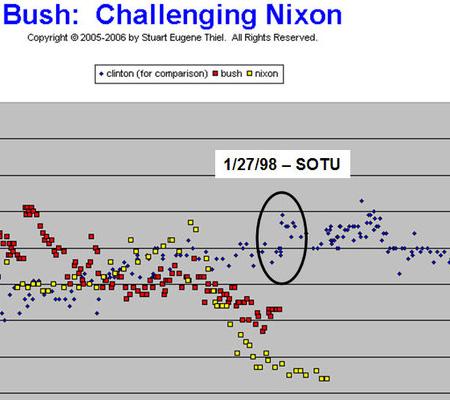
 This evening I should get home just in time to make a vodka martini (shaken, not stirred), nuke a bag of popcorn and put my feet up to listen to the State Of The Union Address. Our president needs to hit one out of the park as this graphic from
  Just to throw some more fuel on the fire in the
  Our world is filled with beauty.
  Eleven months ago in
  I was born in Marietta, Ohio, but the Hess family line lived along the banks of the Monongahela River at Palantine (later Fairmont) Virginia for nearly 250 years. During the War of Northern Aggression it became West Virginia and about a hundred years later we moved downstream to the confluence of the Muskingham and Ohio rivers.
 Tim Wu offerred an interesting analogy with a coffee twist on the head butting between

 On 22 January 1973, the Justic Blackmun delivered the opinion of the court in the case of Roe v. Wade. Every year, on the anniversary of the decision, the Pro-Choice and Anti-Abortion groups have rallied in Washington. For the past six years, President George Bush has managed to be out of town on that day.
 It looks like the NEO/Theocon Talking Points generator has kicked into overdrive concerning Massachusetts’ Senator Ted Kennedy. I’m no fan of the rotund-one (my copy of