Vermont Senator Jim Jeffords introduced Senate Bill S. 3698, the Global Warming Pollution Reducation Act Jeffords, at least, seems to have heard Al Gore’s message loud and clear and sees his bill as setting the United States on a path to decrease and, in time, reverse the emissions of greenhouse gases that cause global warming.
In describing the challenge, Sen. Jeffords said, The science is clear, mankind is heating the planet in a manner that is destructive. We can no longer afford to watch from the sidelines. We are a nation of innovators, and we have the skills to develop the technology to make these needed changes.
The Findings section of S. 3698 says that:
Congress finds that–
(1) global warming poses a significant threat to the national security and economy of the United States, public health and welfare, and the global environment;
(2) due largely to an increased use of energy from fossil fuels, human activities are primarily responsible for the release of carbon dioxide and other heat-trapping global warming pollutants that are accumulating in the atmosphere and causing surface air and subsurface ocean temperatures to rise;
(3) as of the date of enactment of this title, atmospheric concentrations of carbon dioxide are 35 percent higher than those concentrations were 150 years ago, at 378 parts per million compared to 280 parts per million;
(4) the United States emits more global warming pollutants than any other country, and United States carbon dioxide emissions have increased by an average of 1.3 percent annually since 1990;
(5) (A) during the past 100 years, global temperatures have risen by 1.44 degrees Fahrenheit; and
(B) from 1970 to the present, those temperatures have risen by almost 1 degree Fahrenheit;
(6) 8 of the past 10 years (1996 to 2005) are among the 10 warmest years on record;
(7) average temperatures in the Arctic have increased by 4 to 7 degrees Fahrenheit during the past 50 years;
(8) global warming has caused–
(A) ocean temperatures to increase, resulting in rising sea levels, extensive bleaching of coral reefs worldwide, and an increase in the intensity of tropical storms;
(B) the retreat of Arctic sea ice by an average of 9 percent per decade since 1978;
(C) the widespread thawing of permafrost in polar, subpolar, and mountainous regions;
(D) the redistribution and loss of species; and
(E) the rapid shrinking of glaciers;
(9) the United States must adopt a comprehensive and effective national program of mandatory limits and incentives to reduce global warming pollution emissions into the atmosphere;
(10) at the current rate of emission, global warming pollution concentrations in the atmosphere could reach more than 600 parts per million in carbon dioxide equivalent, and global average mean temperature could rise an additional 2.7 to 11 degrees Fahrenheit, by the end of the century;
(11) although an understanding of all details of the Earth system is not yet complete, present knowledge indicates that potential future temperature increases could result in–
(A) the further or complete melting of the Antarctic and Greenland ice sheets;
(B) the disruption of the North-Atlantic Thermohaline Circulation (commonly known as the Gulf Stream’);
(C) the extinction of species; and
(D) large-scale disruptions of the natural systems that support life;
(12) there exists an array of technological options for use in reducing global warming pollution emissions, and significant reductions can be attained using a portfolio of options that will not adversely impact the economy;
(13) the ingenuity of the people of the United States will allow the Nation to become a leader in solving global warming ; and
(14) it should be a goal of the United States to achieve a reduction in global warming pollution emissions in the United States–
(A) to ensure that the average global temperature does not increase by more than 3.6 degrees Fahrenheit (2 degrees Celsius); and
(B) to facilitate the achievement of an average global atmospheric concentration of global warming pollutants that does not exceed 450 parts per million in carbon dioxide equivalent.
I think that pretty well sums it up. S. 3698 is 70 pages long and as with any bill, the devil is in the details. What do you find buried inside that is important to you?
My Soundtrack: 0078h by M83 on WOXY.

 My name is Jeff Hess and I’m a biblioholic. I own hundreds of books. Not valuable books, mostly Science Fiction paperbacks and text books, tomes rescued by the bag from library book sales. A few years ago, in the interest of not burying myself, I began reading more books from the library and taking notes. My electronic chapbook was born.
 The dead-tree media thinks it can provide stories on every page of its newspapers that will attract 13-17 year-olds without alienating its much older, graying and dying present audience. At least that’s what the Newspaper Association of America Foundation in its
  On 15 January 1975 I reported for basic training at the Navy’s Great Lakes Training Center. As winter recruits we were always bundled up in our peacoats with our collars up and our watch caps pulled down over our ears. The result was that we were black from head to toes with only our closely shaven skin of our faces exposed to the cold.
 Andrew Sullivan calls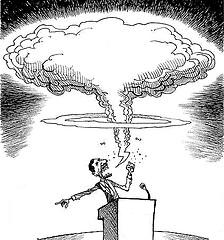
 I love it when blogosphere serendipity happens. Our brain’s greatest function is its ability to connect the dots. This morning MetaFilter led me over to
  If the 16th century belonged to the protestant and the 20th century to the industrialist, then the 21st century belongs to the geek. But if geeks will claim their rightful post, they must learn to speak and be heard; to recognize those things that bind them together. In that vein, Devanshu has published

 I’m starting to wonder at what point do I feel the sting of Jim’s tranguilizer dart and wake up with a numbered tag on my ear and a radio collar that