NOT THE MARIETTA TIMES…
0400 by Jeff HessSince the Marietta Times does not publish a Sunday edition, what was your favorite story this week? What story did the Marietta Times not report or under-report this week?

Since the Marietta Times does not publish a Sunday edition, what was your favorite story this week? What story did the Marietta Times not report or under-report this week?
Local News
Preservation
Heroin addicts face barriers to treatment
Heartbleed virus: Local officials urge caution online
Vet’s ‘smart home’ almost ready
Spotlight on Belpre Church: Pioneer PresbyterianDo you think enough is being done to preserve our historic places?
If you’ve read your Friedrich Nietzsche, you know that the consummate anti-philosopher had a pretty cynical take on this question. Nietzsche didn’t simply call free will itself “the foulest of all theological fictions.” In his work Twilight of the Idols he went further, psychoanalyzing the ubiquitous belief in free will and concluding that deep down, we want to believe that people have control over their own choices so that we can justify and feel good about punishing them. “Whenever responsibility is assigned,” wrote Nietzsche, “it is usually so that judgment and punishment may follow.”
Modern psychological research suggests that Nietzsche was on to something. In fact, in a new study in the Journal of Personality and Social Psychology, a team of authors from several universities (the University of California-Irvine, Yale University, and two others) have put Nietzsche’s thesis to the experimental test. “We propose that the pervasive belief in free will partially flows from a desire for moral responsibility in order to justify punishing others for their anti-social behaviors,” state the authors. “Therefore, when there is a desire to punish, people should be motivated to believe in free will.”
For 10 years I took part in the Socrates Café of Cleveland, a once-a-month meeting of people who enjoyed intelligent conversation. We visited the subject of Free Will more than once, but the one I remember the most was when we discussed the question, If Free Will, as research indicates, does not exist, how ought that fact inform our legal system? If criminals are not actually responsible for their actions, if we do live in a Skinnerian world, what do we do about those who injure others in our society?
As was usual, we came to no conclusions, but I remember suggesting that perhaps one solution might be a two strikes and your out system where law breakers would be given a second chance to make good their crime and rejoin society. If they transgressed a second time then they would be euthanized like a mad dog.
I was intentionally extreme because I thought a world without free will naturally lead to that conclusion. Personally, I continue to cling to the idea of free will, but my purchase seems to be getting more and more tenuous as the evidence rolls in.
From Famous Writers’ Sleep Habits vs. Literary Productivity, Visualized:
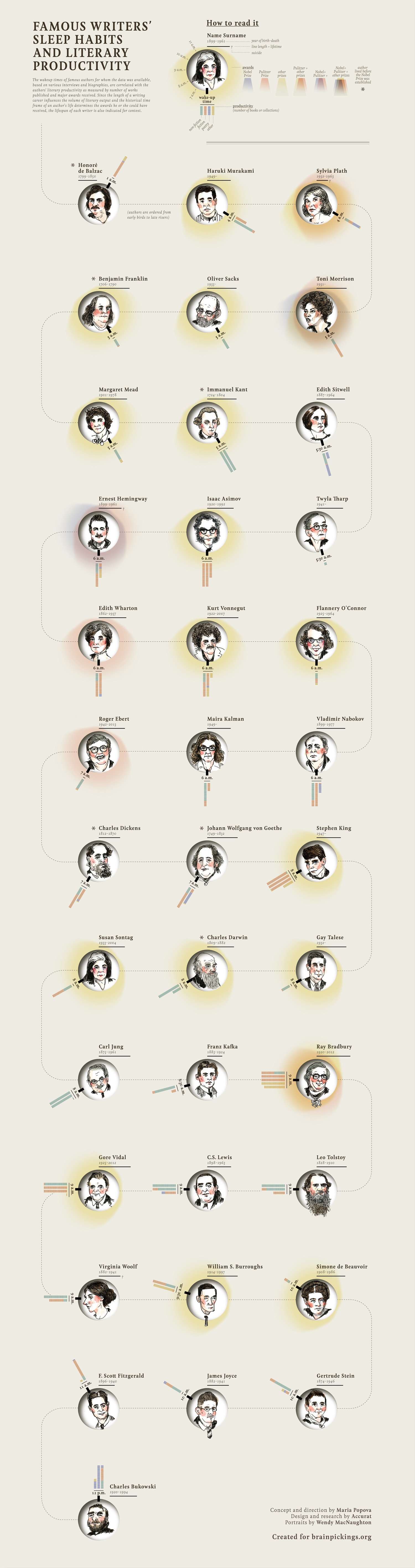
I’m somewhere between Haruki and Toni…
I left this comment on Mano Singham’s blog this morning concerning his post: They are not ‘bug splats’ which focuses on a project to put human faces on those killed by U.S. drone strikes.
I am much less concerned about the lack of compassion in the drone operators than I am in the remove of those civilians in Washington who directly or indirectly order those operators to kill and the populace of the United States who, by virtue of their citizenship, are ultimately responsible for any deaths.
Bug splat is mild compared to what I heard during my 11 years in service.
Rather than get upset the psychological tricks those ordered by their government to kill use to be able to sleep at night, I wish those not in the arena would get directly involved in ensuring that those in service do not receive the orders in the first place.
If anyone doesn’t like what our service members do in our name, then they need to get off their ass and do all they can to first, remove the politicians responsible from office, and then work just as hard to prevent their like from ever gaining office in the future.
Do all you can to make today a good day,
Jeff Hess
Have Coffee Will Write
Years ago, when I first read Orson Scott Card’s Ender’s Game, the single most important memory I took away is that those not in the arena are quite prepared to throw those who fight and die in their name under the bus the moment the threat is past.
Local News
Heroin scourge
Heroin scourge: The local view
Missed court date is worth a ticket to jail
Health care reforms debated at Economic Roundtable
Career Center skills on displayThis early in the road project season what’s your stress level driving around town?
I wrote in a comment to today’s Not The Marietta Times:
Now, I find this interesting…
While I was doing a search for general hits on the Marietta Times a few minutes ago, I found that the No. 1 News Story was Teen stabs 22 at Pittsburgh-area high school. Because I expected that the pro-gun commenters would be all over the story, I went to Times‘ front-page to see what was going on and, surprise, surprise, I couldn’t find the headline.
The story is near the bottom of the second page of links for today, 10 April.
As a journalist I understand that a national story such as this must be low priority for a newspaper that cannot hope to compete for news that will be all over the television and radio stations, but I’m betting that the if-teachers-had-guns-this-wouldn’t-have-happened crowd are really upset that they couldn’t beat their chests and wave their little guns in the air.
For the record, I joined the National Rifle Association at 16 as a junior member (and took the NRA Gun Safety course as a Boy Scout), but let my membership lapse five or six years later, not out of protest, because I just wasn’t getting what I thought was any real value from the membership.
I support the 2nd Amendment with the same fervor as I do the 1st, 4th, 5th and 10th amendments, indeed as I do the whole Constitution.
My expectation is that the topic will show up in the forums very soon. Sadly, now that I’m banned from commenting on the Marietta Times, I won’t be adding my voice to that particular discussion.
People who take a strict binary view of culture (“culture of privilege = awesome; culture of poverty = fail”) are afflicted by the provincialism of privilege and thus vastly underestimate the dynamism of the greater world. They extoll “middle-class values” to the ignorance and exclusion of all others. To understand, you must imagine what it means to confront algebra in the morning and “Shorty, can I see your bike?” in the afternoon. It’s very nice to talk about “middle-class values” when that describes your small, limited world. But when your grandmother lives in one hood and your coworkers live another, you generally need something more than “middle-class values.” You need to be bilingual.
Local News
Bikes vs. cars
Robber’s accomplice sentenced
Grand jury will hear unlawful sex case
Seismic testing discussed in Beverly
Interactive sing-along showDo you think coyotes pose a serious danger in Washington County?
The Paris Review: “The Art Of Fiction No. 4” with Irwin Shaw:
[A]lmost every writer will tell you that events that happened to him before he started writing are the most valuable to him. Once he starts writing he seems to observe the world through a filter. I believe that’s true about writers: that the unconscious observation of things, a kind of absorbing of life that goes on before he becomes a writer, that is what is most useful to him. When he starts observing things professionally and taking notes and trying to remember, he may collect a lot more but he loses the spontaneous quality and the flow. He becomes too systematic.
Found in my electronic chapbook…
Bitcoins are the ultimate currency: virtual, anonymous, stateless. They represent true economic freedom, not subject to arbitrary manipulation by any government. Do we have any leads?”
“Not yet. But mark my words: we’re going to figure out who did this and we’re going to take them down … provided someone pays us a fair market rate to do so.”
“Easy, chief,” I said. “Any rate the market offers is, by definition, fair.”
He laughed. “That’s why you’re the best I got, Lisowski. Now you get out there and find those bitcoins.”
“Don’t worry,” I said. “I’m on it.”
I put a quarter in the siren. Ten minutes later, I was on the scene. It was a normal office building, strangled on all sides by public sidewalks. I hopped over them and went inside.
“Home Depot™ Presents the Police!®” I said, flashing my badge and my gun and a small picture of Ron Paul. “Nobody move unless you want to!” They didn’t.
Of course, Fry and Laurie got there first…
Local News
Jailhouse blues
Suspect tries to get statement nixed
Important city job vacant following retirement
State issue will raise money for infrastructure projects
Agreements on 7th, Pike projectWhat is your opinion of traffic cameras?
At one of my schools we are having a discussion about the value of restorative justice in the school environment beginning from an article titled: Syracuse school board: ‘Restorative justice’ is the path to improving school discipline, which includes links to a New York Times Op-Ed and a further discussion at the Seeds Of Peace program in Syracuse.
This morning I passed around links to and The new school detention, where kids make rules and a prison pipeline ends.
In the last, written by Dana Goldstein, I found this:
These new kid courts, in which students are empowered to set school rules and mete out the punishments for breaking them, are sometimes called “restorative justice”. The concept, borrowed from the world of legal mediation, shows real evidence of working in schools. Using restorative tactics, Lyons decreased its suspension rate by more than 20% since 2008.
Now Lyons is part of a growing national movement of educators offering a practical alternative to harsh “zero tolerance” school discipline policies, which proliferated in the wake of the 1999 shootings at Columbine High School in Colorado. Though the Columbine massacre was perpetrated by two white students at a majority-white, suburban school, it is urban students of color who have shouldered the heaviest burdens of the zero-tolerance push. Those kids have the most to gain from radically upending how school discipline gets done.
There is data to back up what activists call the “school-to-prison pipeline”: 20% of black boys and 12% of black girls are suspended from school each year in the United States, compared to 6% of white boys and 2% of white girls. 95% of those school suspensions are for non-violent offences like verbally disrupting class. Yet once suspended, students experience academic delays and become twice as likely to drop out, get involved in street violence, then get sucked into the criminal justice system.
My educational mentor, Mona Senkfor, pioneered this concept more than 15 years ago when she created a high school class call Beit Din (Hebrew for Rabbinic Court). Mona had great success with the class because the student court, our own Beit Din had to learn about the Rabbinic law codes before they were asked to sit and hear the cases that were brought before them.
The comments from naysayers on these stories notwithstanding, I think, speaking from experience, that the model does work.
Over the last two months I’ve been jonesing for Keith Knight’s left-coast humor but when I visited his blog each day and clicked on the Read Keef’s daily cartoon link I always found myself looking at the Sunday strip from 2 February.
I figured that Keith was having family problems and focusing his attentions elsewhere. This morning, by accident, I discovered I was wrong and that it was only the link on his blog that hadn’t been updated since February. The daily cartoons are all there on Go Comics!
 I feel much better now.
Local News
Celebration!
Mumps awareness
Renewal levy for Warren
the sky’s really the limit
Hair Hoopla: Raising cancer awarenessHow would you describe this area’s level of heroin use?
Not least, whenever possible, I like to sleep on whatever I’ve written. I’ll put a piece aside, wait a day or two, print it out, and invariably notice deficiencies and opportunities for improvement that I had somehow overlooked.
Let me end with a handful of writing axioms that are always floating in the back of my mind: keep things lively and moving right along. Avoid repeating words. If any passage seems boring, it is boring: cut it or change it. Be grateful for good editors and heed their suggestions. Above all, remember that writing that isn’t fun to read doesn’t get read.
I am of the opinion that at least 30 minutes and ideally, 24 hours should pass before replying to any email. The same is true with leaving voice mails. Both create records of what may be unusual moments in our emotional and mental states that we would not like to think of as our norm.
When we speak off-the-cuff people give us some leeway because, when we talk face-to-face, we allow them to experience the myriad visual and other cues that create a subtext for what we say. We lose that in emails and voice messages.
We seldom regret the message we didn’t leave.




Powered by Wordpress | Design by Ash Haque
XHTML Strict | RSS Entries


