9 December 2012

PEE DEE SNOOZES WHILE HISTORY IS MADE…

1647 by Jeff Hess

[Update at 1647 — Anastasia Pantsios weighs in on the story:

People involved in the “Save the Plain Dealer” campaign are asking “Where will we get our news?” Maybe we should respond, “Well, where do we get it NOW?” The PD may currently publish seven days a week and have a staff a third larger than what is being proposed but it leaves its readership uninformed or misinformed about so many issue with major impact on their lives. “Saving” a paper that in its present form ignores the voices coming from the bottom, doesn’t hear masses of people speaking out against injustice, and whose response to things like police brutality is often “Why don’t ‘those people’ just behave better?” is a mission it’s hard to feel passionate about.

Well said (and written Anatasia…]

Tim Russo writes [orignally published at 0856]:

Mr. Egger, Ms Simmons,

As a daily newspaper facing extinction, guardians of the First Amendment in Cleveland, your 3 day late coverage of the Thursday decision by the Ohio Court of Appeals declaring the October 21, 2011 arrests of Occupy Cleveland unconstitutional on First Amendment grounds is a disgrace.

Even on a crass profit/loss analysis, your readership has shown an insatiable interest in the Occupy movement, largely from your core readership, older readers who cannot stand that Occupy exists, who descend upon every mention of Occupy to attack it. At this moment, when revenue seems to drive every decision you make, burying this story on Metro page B3, three days after the decision was published, is odd to say the least.

But most of all, can you tell me the last time any law in Cleveland was struck down on First Amendment grounds? You are the vanguard of the First Amendment in this city, an incredible privilege. These arrests occurred on ground called literally Public Square, named after Mayor Tom Johnson and dedicated to free speech itself. The court’s opinion even goes out of its way to note this historic tie to free speech – did you even see that? Here’s the opinion, you really ought to read it.

On the night of these arrests, every single local TV station covered them live, and the only vehicles outnumbering satellite trucks at Tom Johnson quadrant were police. We now know that even the FBI was there. The full power of the state was documented from every angle, on live television, targeting the First Amendment. Has there ever been a more frontal police power assault on the First Amendment in the history of Cleveland? Moreover, the Occupy Cleveland arrests were one of the first evictions of an Occupy encampment in the entire country, nearly a month before the eviction of Occupy Wall Street in Zuccotti Park.

By any measure, this story is not just news, it is historic, placing Cleveland into American history’s DNA. Metro section B3? Really?

It was your newspaper’s right, this entire city’s right, to free speech that was attacked, and a court finding that attack unconstitutional on First Amendment grounds should be celebrated by your newsroom. At a minimum, though, as your newspaper fights for survival, it’s incredibly sad to watch you purposefully ignore a story so utterly Cleveland, so draped in Cleveland history, tying Cleveland to the founders ideals so directly. Your reporter didn’t even call the city for reaction. Pathetic.

If your newspaper can’t find joy in this story, why should any Clevelander support your campaign to survive as our city’s First Amendment flagship? If you don’t care about your First Amendment right to even exist, why should we care?

tim
9 December 2012

FOR THE WORDS TO CONSUME ALL THAT WE ARE…

1640 by Jeff Hess

Generally I don’t care for the Q&A (Playboy interviews — I still have the photocopy my dad gave me of October 1967 interview with Jim Garrison with all the cartoons block out –notwithstanding) format because I find the questions mostly innane and the answers nearly always lifeless and well rehearsed from too oft asking.

While By The Book’s questions don’t disappoint, Ian McEwan gave answers that, might be rehearsed, but tolled for me.

One of my favorite questions to writers is how do you read? I’ve never gotten an immediate response because the question is more than a bit odd. McEwan was not faced with that question, but his response to Do you read poetry? (a particularly bad question in my opinion) elicited this wonderful, beautiful, telling-beyond-scope response:

[I]t takes an effort to step out of the daily narrative of existence, draw that neglected cloak of stillness around you — and concentrate, if only for three or four minutes. Perhaps the greatest reading pleasure has an element of self-annihilation. To be so engrossed that you barely know you exist. I last felt that in relation to a poem while in the sitting room of Elizabeth Bishop’s old home in rural Brazil. I stood in a corner, apart from the general conversation, and read “Under the Window: Ouro Preto.” The street outside was once an obscure thoroughfare for donkeys and peasants. Bishop reports overheard lines as people pass by her window, including the beautifully noted “When my mother combs my hair it hurts.” That same street now is filled with thunderous traffic — it fairly shakes the house. When I finished the poem I found that my friends and our hosts had left the room. What is it precisely, that feeling of “returning” from a poem? Something is lighter, softer, larger — then it fades, but never completely.

If achieving such self-annihilation is not the grail of any reader (or writer), then I don’t know what is.

I also found these two exchanges interesting:

If you could require the president to read one book, what would it be?

I wouldn’t trouble the president with advice, or with one more transient treatise on America’s supposed terminal decline. For the sake of the general good, I’d have him absorbed in poetry. What would suit him well, I believe, is the work of James Fenton. His “Selected” would be fine. The range of subject matter and tone is immense. The long, wise reflections on conflict (“Those whom geography condemns to war”) would be instructive to a commander in chief, and the imaginative frenzy of “The Ballad of the Shrieking Man” would give him the best available measure of the irrational human heart. There are poems of mischief and wild misrule. A lovely consolatory poem about death is there, “For Andrew Wood.” (“And there might be a pact between/ Dead friends and living friends.”) And there are the love poems — love songs really, filled with a sweet, teasing, wistful lyricism that could even (but probably won’t) melt the heart of a Republican contender. “Am I embarrassing you?” one such poem asks in its penultimate line.

And,

If you could meet any writer, dead or alive, who would it be? What would you want to know?

I apologize for being obvious, but every time I watch the curtain come down on even a halfway decent production of a Shakespeare play I feel a little sorrowful that I’ll never know the man, or any man of such warm intelligence. What would I want to know? His gossip, his lovers, his religion (if any), the Silver Street days, his thoughts on England and power in the 17th century — as young then as the 21st is for us. And why he’s retiring to Stratford. The biographies keep coming, and there’s a great deal we know about Shakespeare’s interactions with institutions of various kinds. England was already a proto-modern state that kept diligent records. But the private man eludes us and always will until some rotting trunk in an ancient attic yields a Pepys-like journal. But that’s historically impossible. He’s gone.

9 December 2012

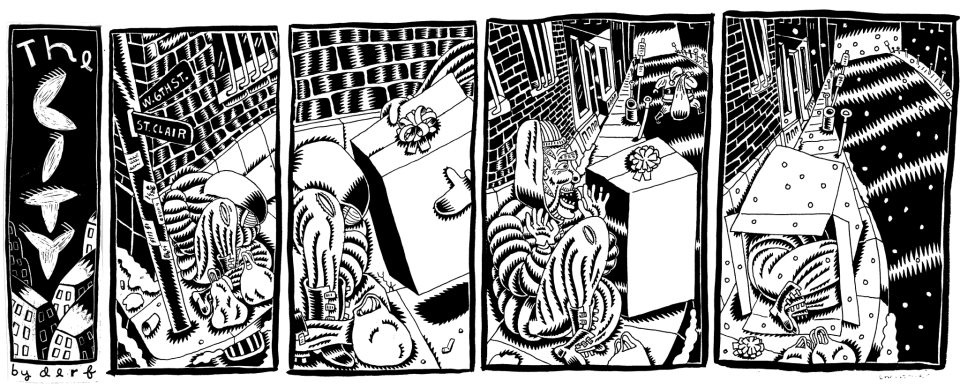
BACKDERF, THE CITY, DECEMBER 1990…

1605 by Jeff Hess

You never know what you’ll find in mom’s basement…

9 December 2012

JUNK FOOD IS KILLING ME (US)…

0704 by Jeff Hess

When asked how I managed to shed 80 pounds in nine months my first response is always: I stop eating junk food.

Watching Emily Bazelon’s presentation on girls with Autism lead me to this quote from Clifford Nass:

Our research shows a link between face-to-face contact and good relationships because that’s the best way to learn to read other people’s emotions. It’s how kids learn empathy, and they have to practice. So it’s like the in-person socializing is the healthy food, and Facebook is the empty calories. It’s like junk food, [emphasis mine, JH] and the more of it kids have, the less time they may have for the healthy stuff.

My problem with Facebook and Twitter is doing to my brain what Burger King and McDonald’s did to my body.

I (we really) have to Put down the Facebook.

9 December 2012

WHAT’S A WRITER TO DO…?

0616 by Jeff Hess

Susan Zakin concludes:

What’s a writer to do? Agent Barer’s oft-quoted advice is: “Don’t quit your day job.” For many writers, it might be: “Don’t quit your three jobs: the one you work to make money and get health insurance, the one you work to make contacts and leverage your own writing, and, yeah, the one you do for love: writing.” In other words, raid Lance Armstrong’s medicine cabinet.

More and more writers are hedging their bets, writing for Big Box publishers but laying the groundwork for a career with smart, feisty new media of one sort or another. They’re not the only ones trying to figure out their next move, according to journalist Jack Hitt. Hitt’s recent book, “Bunch of Amateurs: A Search for the American Character,” casts the tinkerer in the garage who turns out to be Steve Jobs as a foundational American myth. Amateurism emerges when “the culture around you won’t let you out of where you are or into where you want to go,” writes Hitt. In his estimation: “The cyclical turn to the garage is happening now as Americans sense that some great turn in history has come.”

In “The Long Tail,” Anderson notes that the average book in the U.S. sells 500 copies. For writers and editors hoping to improve those odds, the best strategy may not be Fordism—the mass production embraced by big publishers—but a return to traditional American values; in the words of Bill Henderson of Pushcart Press, “happy, cranky individualism.”

9 December 2012

A BEAUTIFUL HOODIE…

0526 by Jeff Hess

Farhad Manjoo writes:

Most people won’t notice these details, but they add up to a remarkable garment. Before I wore American Giant’s hoodie, I couldn’t ever picture a hoodie looking unslouchy. This one makes it look like you spent a minute considering your wardrobe before you rushed out the door.

For a lot of people, this all might sound like overkill—a beautiful hoodie might strike you as oxymoronic and superfluous, and you’d just as well spend your money on high fashion rather than a slacker uniform. But even if you aren’t a fan of sweatshirts, American Giant’s business model is worth watching. Like American Apparel, the company has staked its brand reputation on making its clothes in this country. But American Giant’s rationale isn’t merely a patriotic one. Winthrop argues that by making clothes in America, he can keep a much closer eye on the quality of his garments, and he can make changes to his line with much more flexibility. An Asian manufacturer wouldn’t have been able to do all of the custom, intricate work that American Giant’s clothes required. On some of the hoodie’s seams, for instance, sewers have to run three different pieces of fabric under the machine, a move that required close collaboration between Manoux and SFO Apparel to perfect.

The upshot of this model is not only a revival of American manufacturing—you also get better garments at competitive prices. Winthrop wouldn’t tell me the exact cost structure for each of his sweatshirts, but he did give me ballpark numbers. A basic American Giant sweatshirt costs the factory $12 or more to make—about double what it would cost a foreign factory to make a much lower-quality garment. American Giant pays the factory about $25 to $30 each, and then it sells it to you for $60 and up. Compare this to a model under which you’d buy standard sweatshirt at the mall—say, this $58 Levi’s crewneck. The department store likely buys that shirt from Levi’s for about $30. Levi’s, in turn, pays the factory about $12 to $15 for it, and the factory likely makes it for $6. So you’re paying 10 times what the shirt costs to make, and Levi’s is earning $18 per garment. With American Giant, you’re paying five times what the shirt costs, and American Giant is earning $35. Since there’s no retail middleman, everyone does better under the American Giant model—the clothing company, the factory workers, and you.

9 December 2012

WHEN THE MONEY IS WHAT MATTERS TO YOU…

0453 by Jeff Hess

Susan Zakin writes:

Take the case of Chris Beha, one of the writers who appeared at the Council of Literary Magazines and Presses conference held in New York in early November. Beha is an associate editor at Harper’s Magazine, and he is not anyone’s idea of a mediocre talent. An unassuming genius in the David Foster Wallace mode, Beha studied with Joyce Carol Oates at Princeton. Grove published his first book, a memoir titled “The Whole Five Feet: What the Great Books Taught Me About Life, Death, and Pretty Much Everything Else,” to stellar reviews.

But Beha is really a novelist, not a nonfiction writer. His next book was a novel about a struggling young writer living in Greenwich Village and a girl he loved in college who had abandoned her literary calling for Catholicism. “What Happened to Sophie Wilder” examines the difference between living life and writing about it.

Unfortunately for Beha, the novel violated the cargo cult belief among publishers that nobody wants to read about writers. (If you’re a literary type and tempted to mention that Philip Roth didn’t get the memo on that one, you wouldn’t be the first.) When “Sophie Wilder” failed to win a contract from one of the Big Six, Rob Spillman, editor of Tin House Books, jumped at the chance to publish it. The story has a happy ending: Amazon featured the book as a digital download deal of the day and it wound up No. 1 in literary fiction, selling more than a thousand copies in 24 hours. D.G. Myers, a critic for Commentary magazine, called it, flat out, the best book of the year.

9 December 2012

GOOD GRIEF CHARLIE BROWN…

0433 by Jeff Hess

From Mr. Fish

9 December 2012

MORE REASONS FOR MORE WOMEN IN POLITICS…

0415 by Jeff Hess

Lynn Johnston writes:

I have always wondered what it is that makes boys and men want to run around shooting each other, when a really good, moderated argument would resolve almost anything. My thinking is: If women ruled the world, we’d get the politics over with expediently, thereby saving the civilian population, then do our best to rejuvenate each other’s economies by shopping! This said by someone who admits to having been a street fighter at the age of five!

9 December 2012

IN EACH OTHERS CHEAP SEATS, OF COURSE…

0200 by Jeff Hess

Carlinisms…*

If all the world is a stage, where is the audience sitting?

From my dad, of course…

*I associate this kind of word play with the brilliant comedy of George Carlin

8 December 2012

HAPPY HANUKA: NIGHT I…

1658 by Jeff Hess

From Ralph Solonitz, of course…

8 December 2012

BAT… BALL… HOME…

0451 by Jeff Hess

Matt Taibbi writes:

The Tea Partiers were sick to the point of puking of RINO types like Boehner who are gearing up to put the Republican Party’s name on a massive tax increase and may eventually bend on choice, immigration and gay rights. The Republican establishment, meanwhile, is sick of waking up every morning wondering which of the party’s extremist dingbats has decided that the best way to win national elections is to give interviews calling carbon dioxide a naturally-occurring gas or demanding that unmarried, sexually-active women be barred from teaching children. The disgust these two groups feel for each other is genuine and in some cases may actually exceed the disgust they feel toward opponents on the blue side of the aisle.

8 December 2012

WHAT DOES HAVING AN EMPATHY DEFICIT MEAN…?

0443 by Jeff Hess

8 December 2012

THE RICH HAVE TOO MUCH MONEY…

0421 by Jeff Hess

If you ever needed proof that the rich have too much money, elephant shit coffee seals the deal.

8 December 2012

OCCUPY WINS IN OHIO COURT OF APPEALS…

0352 by Jeff Hess

I just did a quick search on the Plain Dealer’s website and not a peep about this story.

From the Court of Appeals of Ohio, Eighth Appellate District, County of Cuyahoga:

{¶1} For purposes of this opinion, the appeals of both appellants Erin McCardle and Leatrice Tolls have been consolidated.

1 {¶2} Appellants Erin McCardle and Leatrice Tolls appeal their convictions for violating Cleveland Codified Ordinances 559.541 (“CCO 559.541”), which prohibits remaining, without a permit, between the hours of 10:00 p.m. and 5:00 a.m., on an area of downtown Cleveland, Ohio known as Public Square, specifically, the Tom L. Johnson quadrant.

2 They assign the following error for our review:

I. Cleveland Cod. Ord. 559.541 is unconstitutional under the First and Fourteenth Amendments to the United States Constitution.

{¶3} Having reviewed the record and pertinent law, we reverse and remand the trial court’s decision.

I’m ready to start cooking again. Is anyone ready to accept delivery?

8 December 2012

EXCEPT IT IS; AND OH SO RIGHT…

0336 by Jeff Hess

To the 99 percent: organize, organize, organize…

8 December 2012

STOP LOOKING BEHIND THE DAMN CURTAIN…

0200 by Jeff Hess

Carlinisms…*

If work is so terrific, why do they have to pay you to do it?

From my dad, of course…

*I associate this kind of word play with the brilliant comedy of George Carlin

7 December 2012

DID GEORGE BAILEY EVER REALLY EXIST…?

0412 by Jeff Hess

Matt Taibbi writes:

What the banking system really needs is a guy who will step in and force bankers to go back to being boring, risk-averse drips who lend businesses money to buy new equipment or fleets of trucks or whatever. What we have instead are coked-up wannabe big shots straight out of Boiler Room who are washing Mexican drug money and laundering Middle Eastern cash and playing around with wild price-fixing schemes – pretty much everything you can think of that isn’t quietly counting beans and helping grow the economy.

Yeah, he did, in a a way. In the early ’90s I took a leap and started my own business with a small loan from a local bank secured by nothing more than my business plan. A banker, who I later discovered was retiring, took a chance on me. I repaid the loan in full and never looked back. The bank made a few pennies off of me and I like to think the banker went out on a small high, but there was nothing sexy or exciting about the transaction.

I don’t know who Taibbi might nominate, but I have a feeling that anyone who would do well in the job doesn’t want the aggravation.

That’s sad.

7 December 2012

CLEARLY NOT AS HOOKED AS ADVERTISED…

0200 by Jeff Hess

Carlinisms…*

Why is phonics not spelled the way it sounds?

From my dad, of course…

*I associate this kind of word play with the brilliant comedy of George Carlin

6 December 2012

THE LESSON, BEST CRIMINAL MINDS EVER…

0621 by Jeff Hess

I watched last night’s episode on line this morning and I think The Lesson may be the best Criminal Minds ever, not the least of which for the homage to Being John Malcovich.

« Previous - Next »